Hunt Log #1: The 15-Minute IDOR That Almost Got Away

This is the first entry in what will be an ongoing series on Watchtower: raw hunt logs. Not polished tutorials — the actual sequence of decisions, dead ends, and small lucky breaks that turn into (or fail to become) a valid report. Some hunts in this series will end at $0 and I'll write those up too, because the failures teach more than the wins.
Today's hunt happened fast. Fifteen minutes from first request to confirmed data leak. But the interesting part isn't the speed — it's the three moments where I nearly talked myself out of reporting it.
The Target
The target was Noones, a P2P crypto trading platform — think LocalBitcoins-style peer-to-peer trades with escrow. P2P platforms interest me for one specific reason: they're built around *offers*. Every offer is an object with an owner, a price, trade terms, and state. Objects with owners mean access control decisions, and access control decisions are where IDORs live.
My standard recon flow applies to anything with offers: enumerate the API behind the mobile app or web app, find the REST endpoints that power the offer listings, then check what happens when you manipulate identifiers.
Minute 1-5: Mapping the API
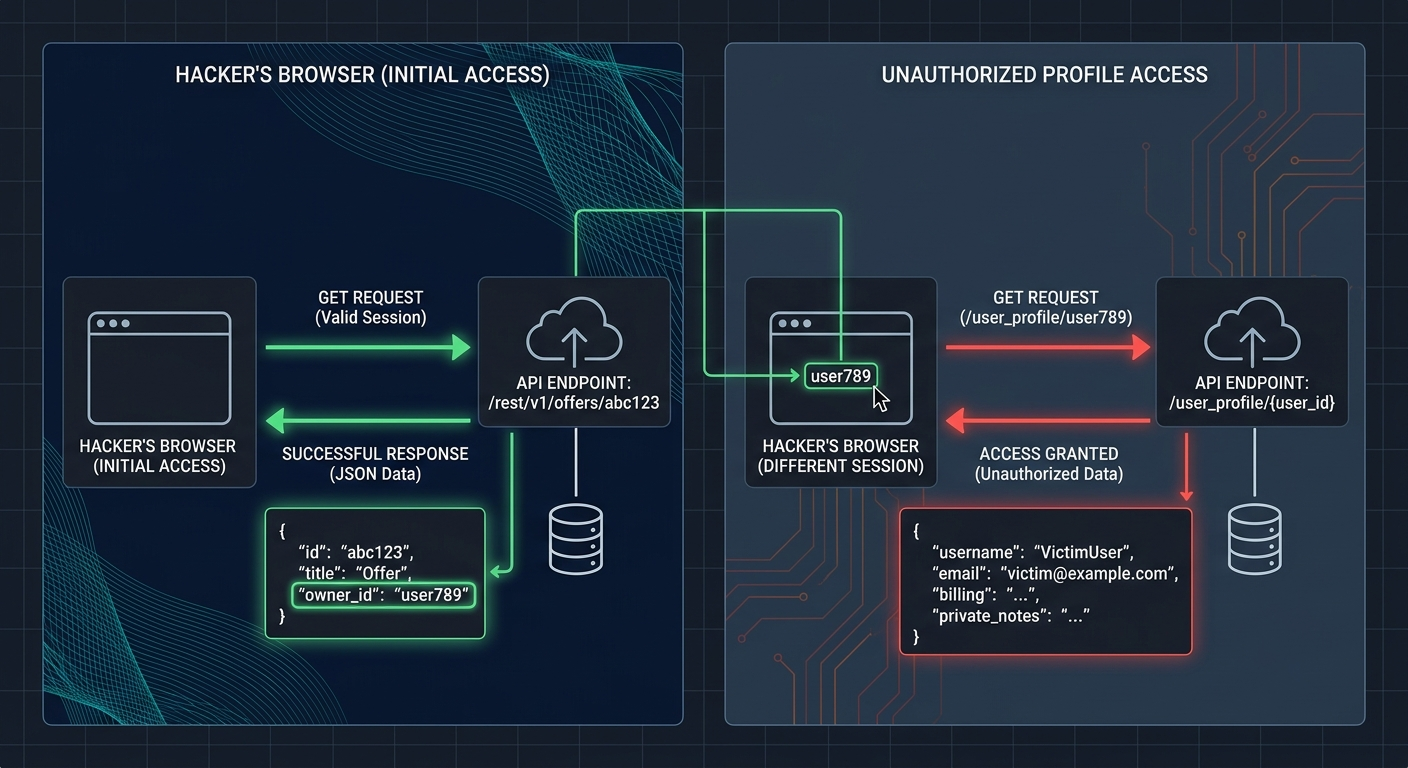
The web app was a SPA talking to a REST backend. Standard stuff: `api.noones.com` underpinning everything, JSON everywhere, predictable resource naming. I won't drop the exact endpoint enumeration process here since responsible disclosure is still fresh, but the shape of it was:
One parameter stood out immediately. Offer detail requests referenced offers by an `idHashed` value — a hash-like string rather than a sequential integer. That's usually good design. Hashed IDs resist enumeration.
Usually.
Minute 5-10: The First "No"
My first instinct — incrementing or fuzzing the hashed ID — failed exactly like it should have. Random hash manipulation returned 404s. Brute-forcing a well-salted hash space isn't a strategy; it's noise generation.
Here's where hunt logs differ from writeups: this is where I almost stopped. The platform had done the obvious thing right, my first attack path was closed, and there were twenty other targets waiting. Moving on would have been defensible.
Instead I asked a different question: what does the server return when the hashed ID is *valid* but belongs to someone else?
Minute 10-13: The Leak
I fetched one of my own offers, copied its `idHashed`, then requested it from a second account. Full offer details came back — including fields that should have been scoped to the owner. Then I tested cross-referencing: could account B fetch account A's offers by harvesting hashed IDs from public listing pages?
Yes. The hashed IDs weren't secret — they appeared in public offer listings. And the detail endpoint didn't verify that the requester owned the offer before returning owner-scoped fields.
That's textbook IDOR: direct object reference, missing authorization check, sensitive data exposure.
Minute 13-15: The Doubt Spiral
Now the part nobody puts in their Twitter victory posts.
Three thoughts hit in sequence, and any one of them could have killed the report:
1. *"It's just offer metadata — maybe it's meant to be public."* Public listings show some fields, sure. But the detail endpoint leaked owner-scoped fields not present in public views. That distinction matters. 2. *"They'll call it informative and I'll lose face."* Possible. But the impact chain — harvest public hashes → enumerate owner details at scale → profile traders — was real. 3. *"Fifteen minutes is too fast. Real bugs take days."* This one is pure imposter syndrome, and it's poison. Speed doesn't invalidate findings.
I wrote the report while the doubt was still loud. Evidence over feelings: side-by-side screenshots of both accounts, the exact request/response pair, and a clear impact statement.
What Triage Taught Me
The report got picked up quickly and validated. But the more useful lesson came from *how* I almost didn't submit it. Every hunter has a threshold of doubt, and the only reliable cure I've found is evidence density: when your screenshots answer questions before triage asks them, submit. When you're writing paragraphs justifying why it *might* be valid, keep hunting until the evidence speaks for itself.
What's Coming in Hunt Log #2
Not every hunt ends in fifteen minutes. Next log covers a hunt that ran three weeks across two platforms and ended at $0 — including the exact moment I realized the entire attack surface I'd been mapping was out of scope. Same format, less flattering outcome.
If you want to see the full evidence trail from this hunt (with credentials redacted), the complete writeup lives here: I Found an IDOR on Noones in 15 Minutes
Related: IDOR Plus XSS: The Bug Chain That Beats Every Single Fix
Disclosure: some links here are affiliate links. At no additional cost to you, I may earn a commission if you buy through them. I only recommend things I've actually used.


Comments
Post a Comment
Thanks for reading! Share your thoughts below