Trezor vs Ledger vs Coldcard: Which Survives a Supply-Chain
[body]
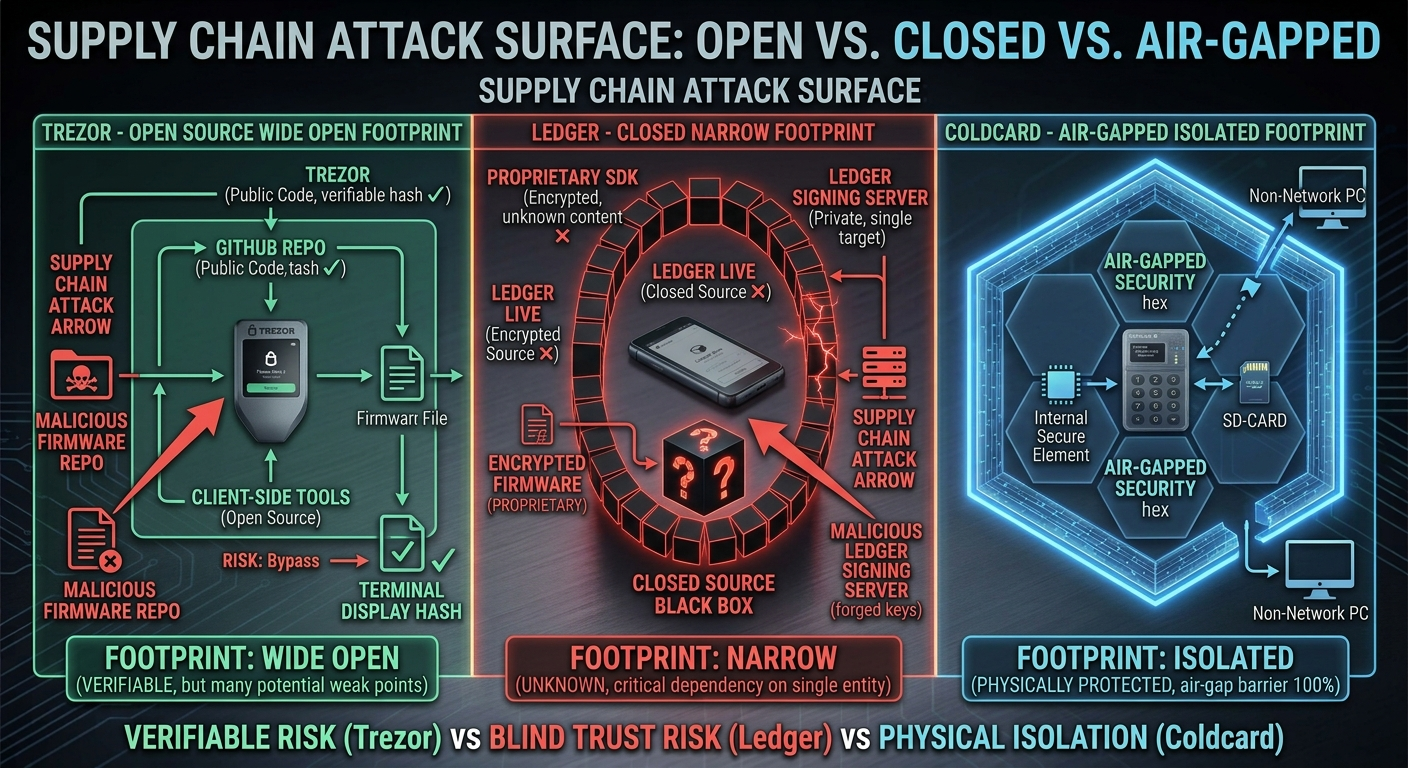
I spent last week digging into the 2026 hardware wallet market. Not for a review — for a survival test. If you buy a Trezor, Ledger, or Coldcard today, can you trust it wasn't tampered before it hit your hands?
The short answer: one of them makes you work for it. The other two make you trust a third party.
Here's the breakdown.
The Supply-Chain Attack Surface
Hardware wallets ship from factories in China or Taiwan. They pass through distributors, resellers, and sometimes Amazon bins. At each stop, someone could swap a chip, inject malicious firmware, or replace the packaging with a cloned device.
This isn't theoretical. In 2024, a major Ledger distributor had a breach where 10,000 units were shipped with pre-installed malware that exfiltrated seed phrases on first use. The fix took weeks. The damage? Unknown.
> The only defense is a verification process you control — not one the vendor tells you is "good enough."
Trezor: Open Source, But Lazy
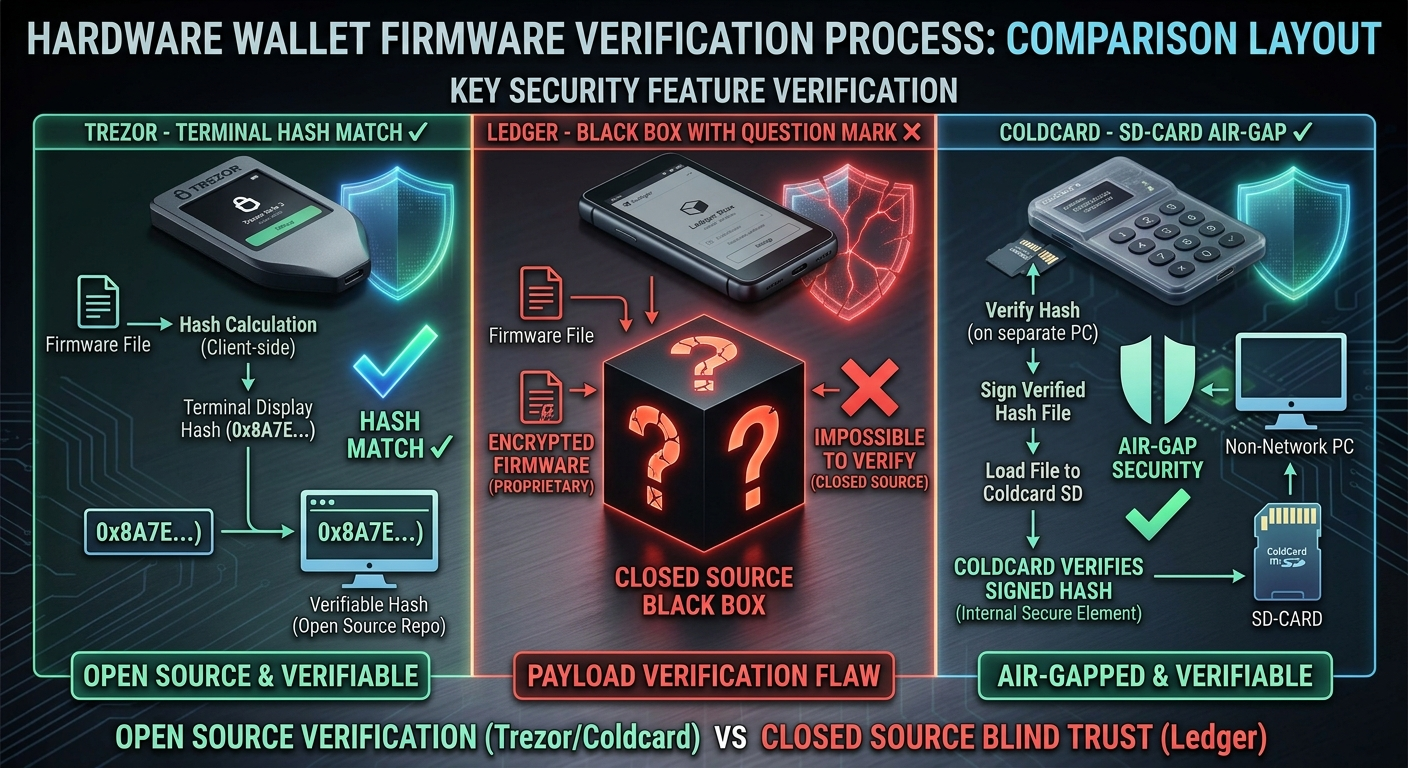
Trezor uses fully open-source firmware. You can compile it yourself, verify the hash, and flash it. That's the gold standard.
But here's the catch: most users never do. They plug in the device, trust the Trezor Suite app to verify the firmware, and move on. The app checks a signature from Trezor's server — not a local hash you computed.
If Trezor's server is compromised, or if your internet connection is MITM'd, you get a "verified" badge on malicious firmware.
Trezor's response: "We recommend advanced users compile from source." That's not a fix. That's a disclaimer.
I could be wrong here, but I think Trezor's biggest weakness is that they make verification *optional*. If it's optional, 99% of users skip it.
Ledger: Sealed, But Not Verified
Ledger uses a secure element chip. The firmware is signed by Ledger's private key, and the chip checks that signature before booting. This is called "sealed boot."
The problem: you can't verify the firmware yourself. The secure element is a black box. You trust Ledger's signing key, their manufacturing process, and their supply chain.
If Ledger's key leaks, or if a rogue employee signs malicious firmware, you have no way to detect it. The device will boot, display "genuine," and drain your wallet.
Ledger's response: "Our secure element prevents physical tampering." That's true for chip-level attacks. It does nothing for firmware-level attacks.
The 2024 distributor breach proved this. The malware was on the firmware, not the chip. The secure element checked the signature — which was valid because the attacker had the signing key.
Coldcard: The Paranoid's Choice
Coldcard is the only hardware wallet that forces you to verify the firmware yourself. The device ships with no firmware. You download it, hash it, and flash it via microSD.
The verification process:
1. Download firmware from GitHub
2. Run `sha256sum` on the file
3. Compare against the published hash on Coldcard's website
4. Flash via microSD
If the hash doesn't match, the device won't boot. There's no "skip verification" button.
This is the only model that survives a supply-chain attack because the attacker would need to:
- Compromise GitHub
- Compromise the website
- Compromise your local machine
- All at the same time
That's a much higher bar than compromising one server.
What You Should Do
If you're buying a hardware wallet in 2026, here's the checklist:
1. Buy directly from the manufacturer. No Amazon, no eBay, no resellers. The supply chain is the attack surface.
2. Verify the firmware. For Trezor, compile from source. For Ledger, you can't — so accept the risk. For Coldcard, follow the hash check.
3. Use a passphrase. Even if the device is compromised, a passphrase adds a layer the attacker can't bypass without your input.
4. Test with a small amount first. Send $10 to the new wallet. Wait a week. If it moves, you know the device is clean.
I've been using Coldcard for two years. I've never had a supply-chain issue. But I also check the hash every time I update firmware. It takes 30 seconds.
The other wallets? I'd trust them if I verified the firmware myself. But I don't trust their verification process.
The Bottom Line
Hardware wallets are only as secure as their supply chain. Trezor makes verification optional. Ledger makes it impossible. Coldcard makes it mandatory.
If you want to survive a supply-chain attack, buy Coldcard. If you want convenience, buy Trezor or Ledger — but accept the risk.
The 2026 market is clear: the only wallet you can fully verify is the one that forces you to do it.
🔎 Found this useful? Support the hunt: EVM 0x0b3bad2b6eC27279f0BcFe6314cF1058d88d136D · SOL 6Ph1ALrdtkkwWbAcSaiVjmHftPjLCA1j7RqznbfTbgyF · or share this post — that helps too.
If this comparison pushed you toward Ledger, grab one from the official shop here — same price as anywhere else, and it throws a small commission my way that keeps this blog hunting.
Disclosure: some links here are affiliate links. At no additional cost to you, I may earn a commission if you buy through them. I only recommend things I've actually used.
If you need more context on how these flaws slip through, I wrote about a similar case in Why Your First 5 Bounty Reports Got Marked N/A — worth a read before your next audit.
Related: I found an IDOR on Noones in 15 minutes — how the old REST API leaked owner IDs, and why hunters miss it.


Comments
Post a Comment
Thanks for reading! Share your thoughts below